
Civic Centre Fleet Teams: Fuel Filling Detection Versus a Fuel Leak
Fuel filling detection versus a fuel leak comes down to one working rule: a rise in the fuel level usually means a refill, while a drop between fueling events that trip distance do
Civic Centre Fleet Teams: Fuel Filling Detection Versus a Fuel Leak monitoring
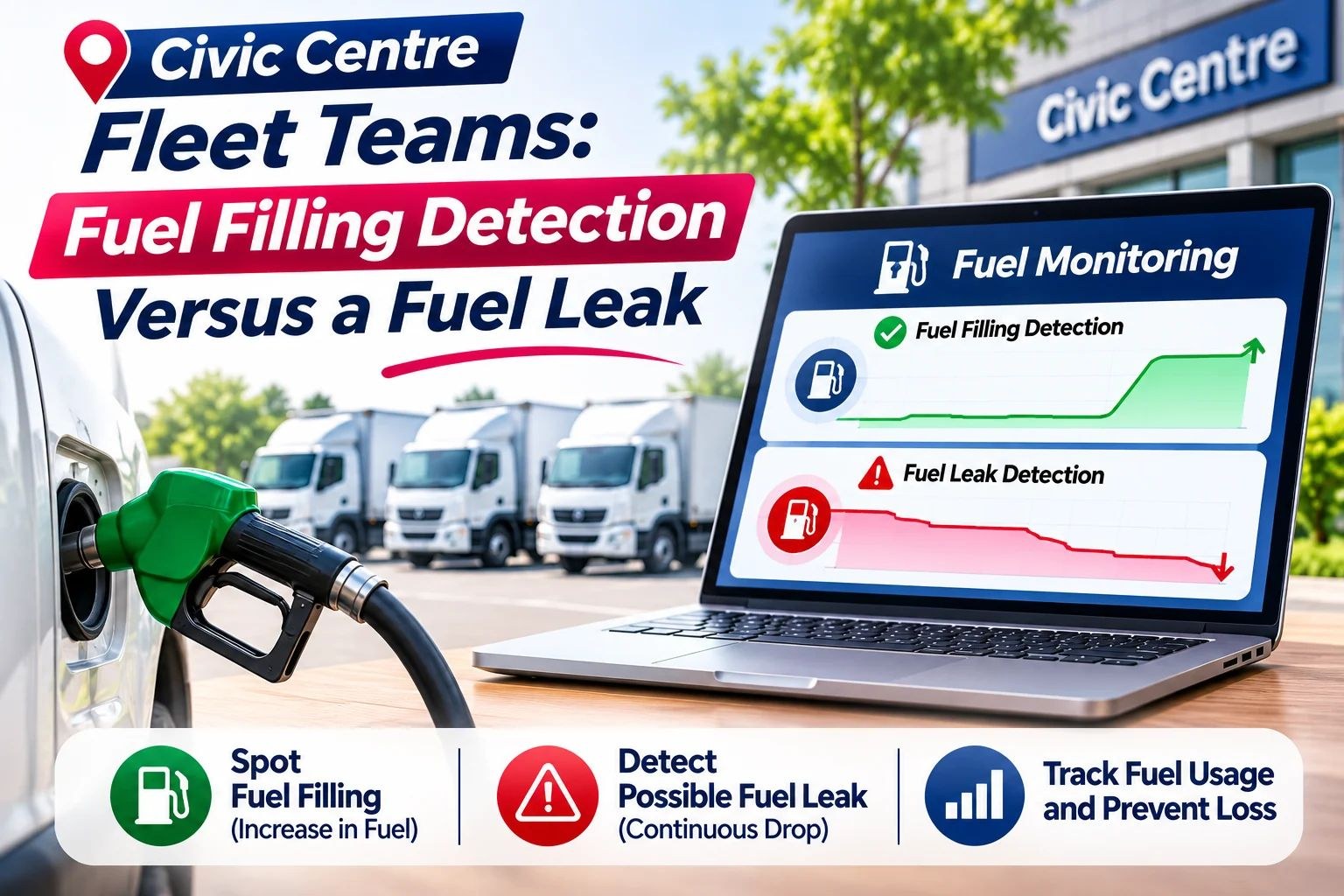
Fuel filling detection versus a fuel leak comes down to one working rule: a rise in the fuel level usually means a refill, while a drop between fueling events that trip distance does not explain usually points to a leak or a loss. The problem is that on screen both appear as a step change nobody watched happen, and the fix is to read that step against ignition state, trip context and where the vehicle was parked.
A fuel level graph is simply the timestamped series of fuel readings a device records for one vehicle. A fueling event is a recorded increase in that level, and trip distance is the distance the vehicle covered between two points. None of the three proves anything alone. Together they show whether a change in fuel matches the work the vehicle actually did.
Why refills and leaks look similar on a level graph
A level graph does not measure litres in a tank. It plots a sensor or CAN signal that the device samples at set intervals, so every change arrives as a number with a time beside it. That matters because a refill and a loss are both just a change in that number, moving in opposite directions, often while nobody is with the vehicle.
Two further things blur the picture. First, resolution. A coarse sensor plus a long reporting interval can turn a small loss into no visible change at all, and a large refill into a partial one. No threshold setting recovers detail the sample rate never captured. Second, timing. If a geofence or fill event is logged after the vehicle has already left the depot, the rise can get matched against a drop from a different stop, and the operator ends up chasing a discrepancy that never happened.
Picture a van that takes a partial fill at a depot, idles in heavy traffic for two hours, then shows a lower level than a simple consumption estimate expects. The arithmetic is right and the reading is still misleading. That is why the comparison should start from the raw event history rather than a summary fuel report.
Signals that point to a refill
A refill leaves a recognisable trail once you line the pieces up. The level steps upward rather than drifting, the step lands inside a stop the vehicle actually made, and the distance covered since the last fill roughly fits the fuel added. A platform view that keeps position, ignition and level on one timeline makes that check quick, which is the practical value of fuel performance monitoring.
Also watch for a rise followed by a steady decline as normal running continues. That shape is ordinary use. So is a rise during a stop with the engine off, then ignition on and movement shortly after. If the refill counter and the level step move by a similar amount, treat it as a fill and move on.
Two fill patterns still deserve a note in the log. A partial fill, where the driver stops short of a full tank, can look odd against an expected-consumption line for the rest of the day. And a fill recorded slightly after the vehicle leaves a site may be real but late, so matching it to the wrong trip is easy. Record the actual stop, not the alert time.
Signals that point to a leak or a loss
A loss looks different in three ways that are worth checking in order. The level falls without a fueling event to explain it. The fall is not matched by trip distance, so the vehicle did not simply burn the fuel by moving. And the drop repeats at the same place or the same hour, which points to a pattern rather than a one-off glitch.
A fuel drop alert is useful here, but only as a prompt to look. It reports a fall faster than an expected consumption estimate, and that estimate is the part under question. A drop alert is not proof of theft, and it is not proof of a leak. It tells you where to read next.
One common trap is treating any downward step as a leak before checking the refill counter, the trip distance and what the driver reported at the stop. A partial fill followed by a long idle period can look almost identical to a siphoning event on a graph. There is a third possibility too: a faulty sender unit can produce a drop that recovers on the next reading. When that happens, log it as a sensor artefact rather than escalating it as a loss.
Related Articles
F F C Okhla Delivery Fleets: Using Trip Playback to Reconcile Routes After a Dispute | Protect your ride with a GPS tracker for bike. Discover how these anti-theft devices offer real-time location, geofencing, and peace of mind. | dwell time monitoring GPS geofence alert for dock doors
The boundary where internal fixes stop helping is worth naming plainly. If the sender is faulty, if fuel leaves the tank where the device has no signal, or if the reporting interval is longer than the window in which the loss occurs, adjusting thresholds will only make the alerts quieter, not more accurate. Reviewing the fuel history through custom reports and analytics usually shows which of those three conditions applies.
What to check before escalating a suspected leak
Start with a week of raw events for the vehicle in question, label each level change as a fill, a loss or a sensor artefact, and only then touch a setting. That order prevents most false escalations.
Refill counter against the level step: if both move by a similar amount, you are looking at a fill; if the level falls with no refill and no ignition cycle, treat it as a loss candidate and check position at that timestamp.
Repeat pattern: a drop that recurs at the same location and time of day is worth investigating, while a one-off step that recovers on the next reading is usually sensor behaviour and belongs in the log as an artefact.
Consumption model versus reality: a level lower than predicted after a partial fill and long idle is arithmetically correct and operationally misleading, so the fix is a model change, not a note in a driver file.
Signal and timing quality: when the device is offline through the window in which the level changed, or the reporting interval is longer than that window, stop tuning and check the device and connectivity layer instead.
Physical check first: inspect the tank and sender before any hardware decision; if that rules out a fault and the level still cannot separate a small loss from noise, the setup needs redesign rather than more threshold work.
Compatibility review: teams weighing a change of device often start by checking what works across all devices before committing, so the fuel view is not rebuilt twice.
The practical close is simple. Reduce each change to fill, loss or artefact using level, ignition and trip distance together, and escalate only what the timeline cannot explain.
Ready to Put This Into Practice for Your Fleet?
GPS Controller supplies commercial 4G GPS trackers, fuel sensors, AI dashcams, cloud tracking software (Web, Android & iOS), and turnkey white-label reseller platforms.
Telematics & fleet technology team at GPS Controller (Sector 62, Noida, India), publishing technical guides on commercial GPS hardware, fuel monitoring, cloud fleet software, and white-label GPS platforms.
Related Telematics Guides
GPS Signal Delay Causing Fleet Tracking Failure
GPS Signal Delay Causing Fleet Tracking Failure GPS signal delay in dense urban areas and under heavy canopy cover causes fleet tracking failure by producing stale location data that does not reflect actual vehicle positions. For connected...
GPS Controller IDC AI spend 1.3 trillion 2029 fleet management core segment 2026
GPS Controller IDC AI spend 1.3 trillion 2029 fleet management core segment 2026 Fleet management in 2026 is the core segment staring down real consequences from the projected $1.3 trillion global AI spend by 2029. GPS signal delay—from inc...
GPS Controller free trial no contract setup in 10 minutes India 2026
GPS Controller free trial no contract setup in 10 minutes India 2026 Fleet managers across India are turning to the GPS Controller free trial no contract setup in 10 minutes India 2026 offer to resolve last-mile connectivity gaps without lo...
GPS Controller Real Time Ignition Engine Hours Total Movement Dashboard 2026
GPS Controller Real Time Ignition Engine Hours Total Movement Dashboard 2026 Operators relying on a GPS Controller real time dashboard for ignition engine hours compared to total movement data in 2026 are encountering persistent tracking fa...