
F F C Okhla Delivery Fleets: Using Trip Playback to Reconcile Routes After a Dispute
Trip playback reconstructs a vehicle's route, stops and timing from stored tracking data, so a disputed delivery can be reviewed against what was recorded rather than against memor
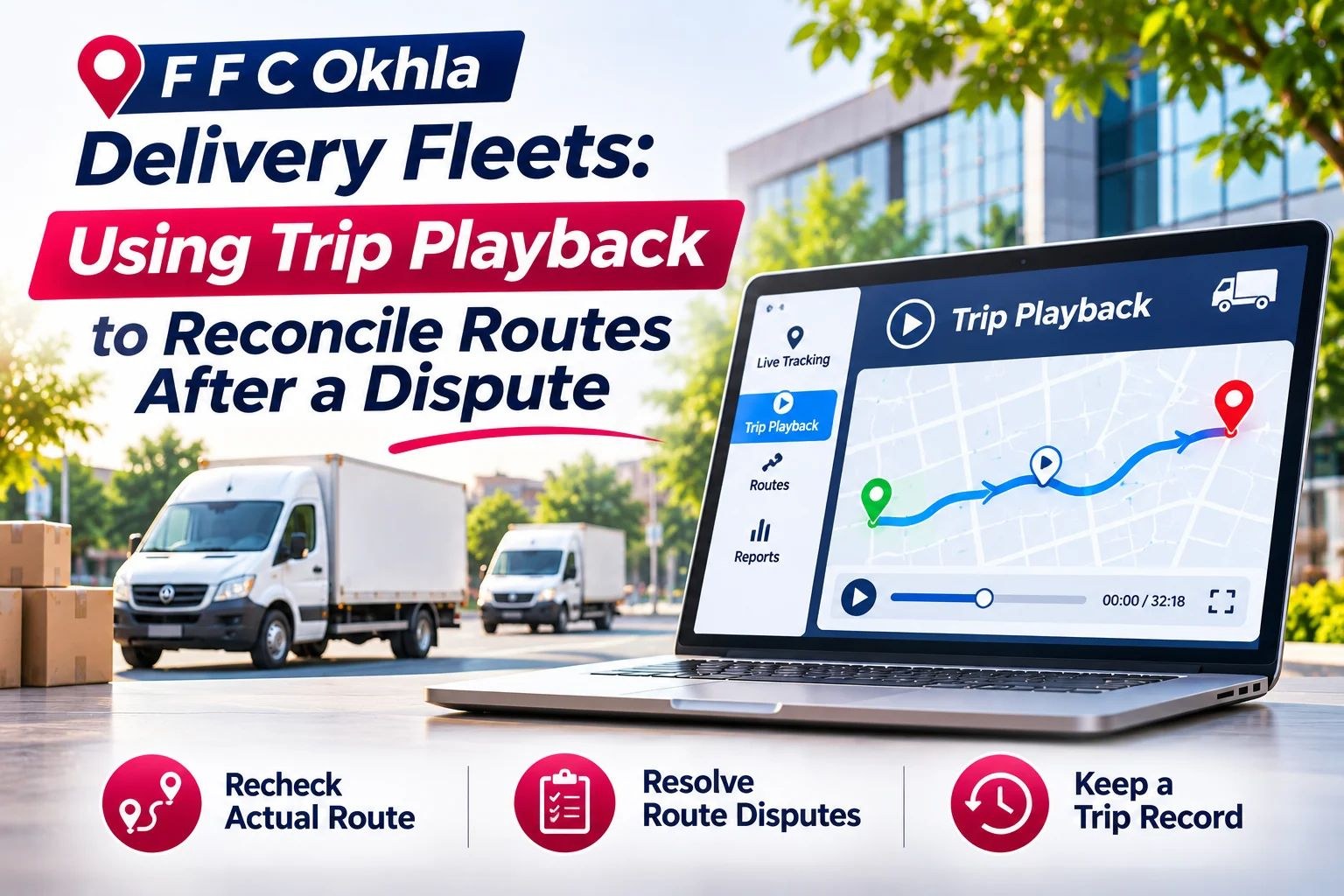
F F C Okhla Delivery Fleets: Using Trip Playback to Reconcile Routes After a Dispute
Trip playback reconstructs a vehicle's route, stops and timing from stored tracking data, so a disputed delivery can be reviewed against what was recorded rather than against memory. In plain terms, it is the replay of saved location points, speed samples and stop records in time order. For F F C Okhla delivery teams, that record is usually the difference between a calm conversation with a customer and an argument nobody can settle.
What trip playback actually reconstructs on a disputed delivery
Playback rebuilds a timeline, not a video. Each stored point carries a timestamp and a position, and usually a speed reading and a heading. The gaps between points are where interpretation begins. A straight line drawn between two distant points is a gap in reporting, not proof that the vehicle took a shortcut. Treat it as unknown ground and say so, because a customer or an auditor will ask.
Playback also rebuilds the sequence of movements: when the vehicle left, when it arrived, where it paused and how long each pause lasted. That is what lets a manager confirm or contradict a claim like "the driver never came to our gate" without relying on anyone's recollection. It shows what happened, not why it happened, and that limit is worth stating up front in any dispute.
The same caution applies to live views. A marker moving on a map is useful for dispatch, but it is not evidence of a completed delivery. If you want the wider picture of how live monitoring and playback differ in practice, the real-time monitoring overview is a reasonable starting point.
Which data points support a review
A playback review stands or falls on which fields you actually pull and how you read them. A small visible table helps here, because it forces the reviewer to separate what each field confirms from what it does not.
| Data point | What it can confirm | What it cannot confirm |
|---|---|---|
| Timestamp | When a position was recorded | That the clock matches your customer's records |
| Position | Where the vehicle was at that moment | Where it was between two points |
| Speed sample | How fast it was moving at that point | How it was driven over the whole trip |
| Ignition state | Whether the engine was on or off | Why the vehicle was stopped |
| Stop record | That a pause occurred and roughly how long | What the driver was doing during it |
| Heading | Direction of travel at a point | The full path taken between readings |
Two practical warnings sit behind that table. First, devices and platforms do not all report at the same interval, so the density of points matters as much as the points themselves. Second, a record pulled too soon after a trip can look thinner than the same record pulled later, once everything has synced. If a review looks incomplete, check the data again before you send anything to a customer.
Reading stops, idle time and start/stop locations
Stops are where most disputes actually live. A long pause at a loading bay and a long pause at a roadside look similar on a chart, and the difference matters when a customer says the delivery was late because the driver disappeared. Start and stop locations help: a stop that begins inside a customer's gate and ends there is easy to defend, while a stop on a public road needs a second source, such as a delivery note or a call log.
Idle time needs the same care. An engine left running during a wait reads as unnecessary idling to a customer and as normal queueing to a driver. Playback can show the duration and the location, but it cannot show the reason. Read the stop against the delivery paperwork before labelling it, and where the evidence is thin, describe it as a wait rather than as idling. For teams that want to compare platforms on how they present this kind of trip data, the GPS tracking solutions overview sets out the standard views.
One more boundary: if the report clock does not match the times on the customer's records, internal reconciliation cannot settle the question. That is a configuration issue to fix at platform level, not a matter of re-explaining the chart.
Documenting the outcome
The review is only as good as the handover. Write down the reference number, the vehicle, the date range, the playback export time and who reviewed it. Note the gaps explicitly rather than leaving them for someone else to notice. Keep the export with the delivery paperwork so a later audit does not depend on re-running the query months afterwards and hoping the settings have not changed.
Related Articles
Gopal Nagar Fleet Owners: Last Known Location When a Vehicle Goes Offline | Civic Centre Fleet Teams: Fuel Filling Detection Versus a Fuel Leak | Compliance Monitoring Buyer Guide for Better Service Visibility
Then decide. If playbacks are broadly accurate and gaps are occasional, tuning the reporting interval and the stop threshold is usually enough. If gaps cluster around particular vehicles or routes, check device behaviour and sync with your provider. If drivers, customers and accounts keep producing three different versions of the same trip, the map is not the problem — the evidence workflow is. Repeated, uncertifiable disputes are the point where a platform built around exportable trip history, such as workflow and setup answers on the platform side, is worth reviewing rather than another round of explanation. Teams that settle a few disputes a week can usually absorb the load; teams with a steady queue cannot, and that is the signal to redesign.
Practical checks before you reply to the customer
Run these checks in order and you will usually know within one pass whether your version of the trip holds.
Confirm the exact time window and vehicle first, so the export matches the claim.
Note every gap in the timeline and mark it as unknown, not as deviation.
Separate stops inside customer premises from stops on public roads.
Match ignition-on waits to the delivery paperwork before calling them idling.
Check that report times and date ranges match the customer's own records.
Record who reviewed the trip, when the export was taken and where it is stored.
Start with one disputed delivery this week. Build the checklist as you go, and keep the export with the trip paperwork so the next review takes minutes instead of an afternoon.
Ready to Put This Into Practice for Your Fleet?
GPS Controller supplies commercial 4G GPS trackers, fuel sensors, AI dashcams, cloud tracking software (Web, Android & iOS), and turnkey white-label reseller platforms.
Telematics & fleet technology team at GPS Controller (Sector 62, Noida, India), publishing technical guides on commercial GPS hardware, fuel monitoring, cloud fleet software, and white-label GPS platforms.
Related Telematics Guides
GPS Signal Delay Causing Fleet Tracking Failure
GPS Signal Delay Causing Fleet Tracking Failure GPS signal delay in dense urban areas and under heavy canopy cover causes fleet tracking failure by producing stale location data that does not reflect actual vehicle positions. For connected...
GPS Controller IDC AI spend 1.3 trillion 2029 fleet management core segment 2026
GPS Controller IDC AI spend 1.3 trillion 2029 fleet management core segment 2026 Fleet management in 2026 is the core segment staring down real consequences from the projected $1.3 trillion global AI spend by 2029. GPS signal delay—from inc...
GPS Controller free trial no contract setup in 10 minutes India 2026
GPS Controller free trial no contract setup in 10 minutes India 2026 Fleet managers across India are turning to the GPS Controller free trial no contract setup in 10 minutes India 2026 offer to resolve last-mile connectivity gaps without lo...
GPS Controller Real Time Ignition Engine Hours Total Movement Dashboard 2026
GPS Controller Real Time Ignition Engine Hours Total Movement Dashboard 2026 Operators relying on a GPS Controller real time dashboard for ignition engine hours compared to total movement data in 2026 are encountering persistent tracking fa...