
Delhi Fleet Owners: Turning Trip and Fuel Data Into a Monthly Cost View
A monthly fuel cost view is simply one period-based picture that brings trip distance, fuel usage and trip records into the same frame, for the same vehicles, on the same calendar.
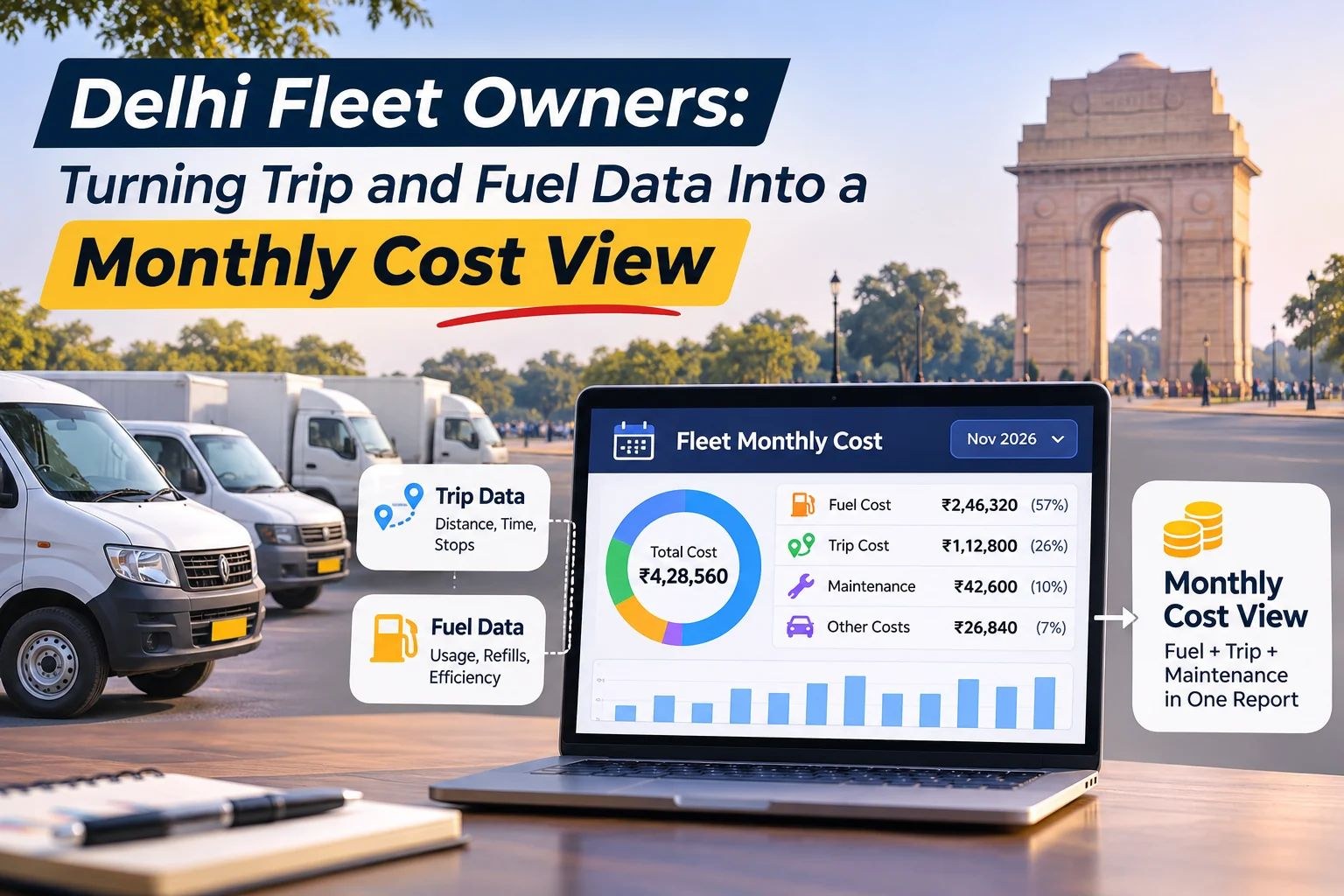
Delhi Fleet Owners: Turning Trip and Fuel Data Into a Monthly Cost View tracker
A monthly fuel cost view is simply one period-based picture that brings trip distance, fuel usage and trip records into the same frame, for the same vehicles, on the same calendar. The practical outcome is a figure you can defend at month-end instead of two reports that disagree. One rule matters more than any dashboard setting: treat a month-over-month change as a signal to check, not a conclusion to act on.
For a small Delhi commercial fleet, the usual problem is not missing data. It is data that was never joined. Trip distance sits in one report, fuel entries or fuel-level readings in another, and the gap between them is what makes a cost per kilometre look wrong in the last week of the month.
What a monthly fuel cost view actually depends on
Three inputs carry the whole picture: distance travelled per vehicle, fuel used over that distance, and trip records that show the distance came from real journeys rather than idle engine time. Trip history is what proves a trip happened, and playback of a single route is the easiest way to sanity-check one vehicle before you trust the fleet total.
Stoppage time belongs in the same frame, because long idling burns fuel without adding distance. If your monthly view ignores idle time, the fuel-to-distance ratio shifts for reasons that have nothing to do with loss or theft. Here is a short list of inputs you control:
- Trip distance, and whether it matches the odometer on a sampled vehicle
- Fuel entries at fill-up, or fuel-level readings from the device
- Idle and stoppage time recorded per trip
- The reporting period you close each month
- How consistently your team records fill-ups and trip notes
Each of these is a question to check in your own setup, not a ranking of one method over another. A vendor with a managed-review workflow will ask you the same questions before quoting anything.
How trip history and fuel reports feed the same monthly picture
Trip records have to close before fuel reports are reconciled. When a trip lands late, its distance slips into the next period and drags the fuel ratio with it, so the order of closing matters as much as the numbers inside each report.
Two clocks are running here. Distance comes from movement over time; fuel comes from fill-up entries or sensor readings. If either stream arrives with a delay, the two will not line up even when both are correct. So check your own setup rather than assume: compare one vehicle's trip playback against its odometer, confirm when its fuel events are timestamped, and see whether a late upload or a device clock that disagrees with the platform is moving events across your month boundary. Five minutes on a single vehicle tells you more than an hour on a fleet average.
Custom reports and analytics help here mainly by putting scheduled exports of trip and fuel data on one calendar and one vehicle scope. That is the join that turns two reports into a cost view.
Reading month-over-month changes without assuming a single cause
A single month's change has many possible causes: route mix, load carried, idling, a change of driver, or simply incomplete filling records. None of these prove a fuel loss on their own, and a fuel drop is not proof of theft until the report window itself is verified.
Before you escalate to a driver or a supplier, ask three plain questions. Did the reporting window shift? Did the same vehicle drift in the same direction for several months or only this one? And can every fuel event be paired with the trip it belongs to? If the answer to that last one is no, the monthly view is not yet defensible and the fix is upstream in your record-keeping, not in a conversation.
Look for consistency across several months before drawing a conclusion. Random small errors point to tuning the reporting window and how streams are joined. A repeating directional drift on the same vehicles points to a data path that was never designed for monthly accounting. These are observational signals only; none of this is a guarantee of savings or a claim about how any platform performs.
Related Articles
Chanakya Puri: Using Live Location and Last Known Location When a Vehicle Goes Offline | Najafgarh Fleet Owners: Using Trip Playback to Reconcile Routes After a Dispute | GPS Tracker Smartphone App Compatibility Hides Real-Time Fleet Data Delays
Practical first steps for a small Delhi commercial fleet
Keep the first steps small and repeatable. A fleet running delivery vans or taxis across Delhi does not need a redesign in week one, just a clean baseline.
- Fix one reporting period and close trips before reconciling fuel, so late events stop shifting across months.
- Record fill-ups consistently, with time and vehicle, for at least one full month.
- Pull trip history and fuel reports together for the same vehicles, and review them side by side rather than one at a time.
- Sample one vehicle first. Compare its route playback and odometer reading before you judge the fleet average.
- Compare two or three months before acting, and note route mix, load and idle time alongside the fuel figure.
If your team can complete those five steps without a manual chase, the cost view is workable. If the same vehicle keeps drifting no matter how carefully you record, that is the point to review the data path itself rather than the numbers it produces.
Checks worth repeating each month
Close trip records first. If fuel reports are reconciled before trips close, distance moves between periods and the ratio misleads you.
Verify the reporting window before calling a fuel drop a loss. Shift the window, then look again.
Isolate one vehicle before judging the fleet. A single device behaving oddly can distort an average with no real cost change.
Keep idle and stoppage time in the same report. Fuel burned while stationary changes the picture without changing distance.
Write down what you changed. Next month's comparison is only useful if you can tell which adjustments came before it.
Use the same period and the same vehicle list every month, or the comparison measures your reporting habits rather than the fleet.
A simple action to take now: collect your last three months of trip history and fuel records for one vehicle, put them on one calendar, and check whether the story holds together before you extend the method to the rest of the fleet.
Ready to Put This Into Practice for Your Fleet?
GPS Controller supplies commercial 4G GPS trackers, fuel sensors, AI dashcams, cloud tracking software (Web, Android & iOS), and turnkey white-label reseller platforms.
Telematics & fleet technology team at GPS Controller (Sector 62, Noida, India), publishing technical guides on commercial GPS hardware, fuel monitoring, cloud fleet software, and white-label GPS platforms.
Related Telematics Guides
GPS Signal Delay Causing Fleet Tracking Failure
GPS Signal Delay Causing Fleet Tracking Failure GPS signal delay in dense urban areas and under heavy canopy cover causes fleet tracking failure by producing stale location data that does not reflect actual vehicle positions. For connected...
GPS Controller IDC AI spend 1.3 trillion 2029 fleet management core segment 2026
GPS Controller IDC AI spend 1.3 trillion 2029 fleet management core segment 2026 Fleet management in 2026 is the core segment staring down real consequences from the projected $1.3 trillion global AI spend by 2029. GPS signal delay—from inc...
GPS Controller free trial no contract setup in 10 minutes India 2026
GPS Controller free trial no contract setup in 10 minutes India 2026 Fleet managers across India are turning to the GPS Controller free trial no contract setup in 10 minutes India 2026 offer to resolve last-mile connectivity gaps without lo...
GPS Controller Real Time Ignition Engine Hours Total Movement Dashboard 2026
GPS Controller Real Time Ignition Engine Hours Total Movement Dashboard 2026 Operators relying on a GPS Controller real time dashboard for ignition engine hours compared to total movement data in 2026 are encountering persistent tracking fa...