
New Delhi G.P.O. Delivery Teams: Reading Fuel Drop Alerts Before Losses Add Up
A fuel drop alert is a measured fall in fuel level over a set period, nothing more. It does not name a cause. Delivery teams in New Delhi G.P.O., and anywhere else, need to read th
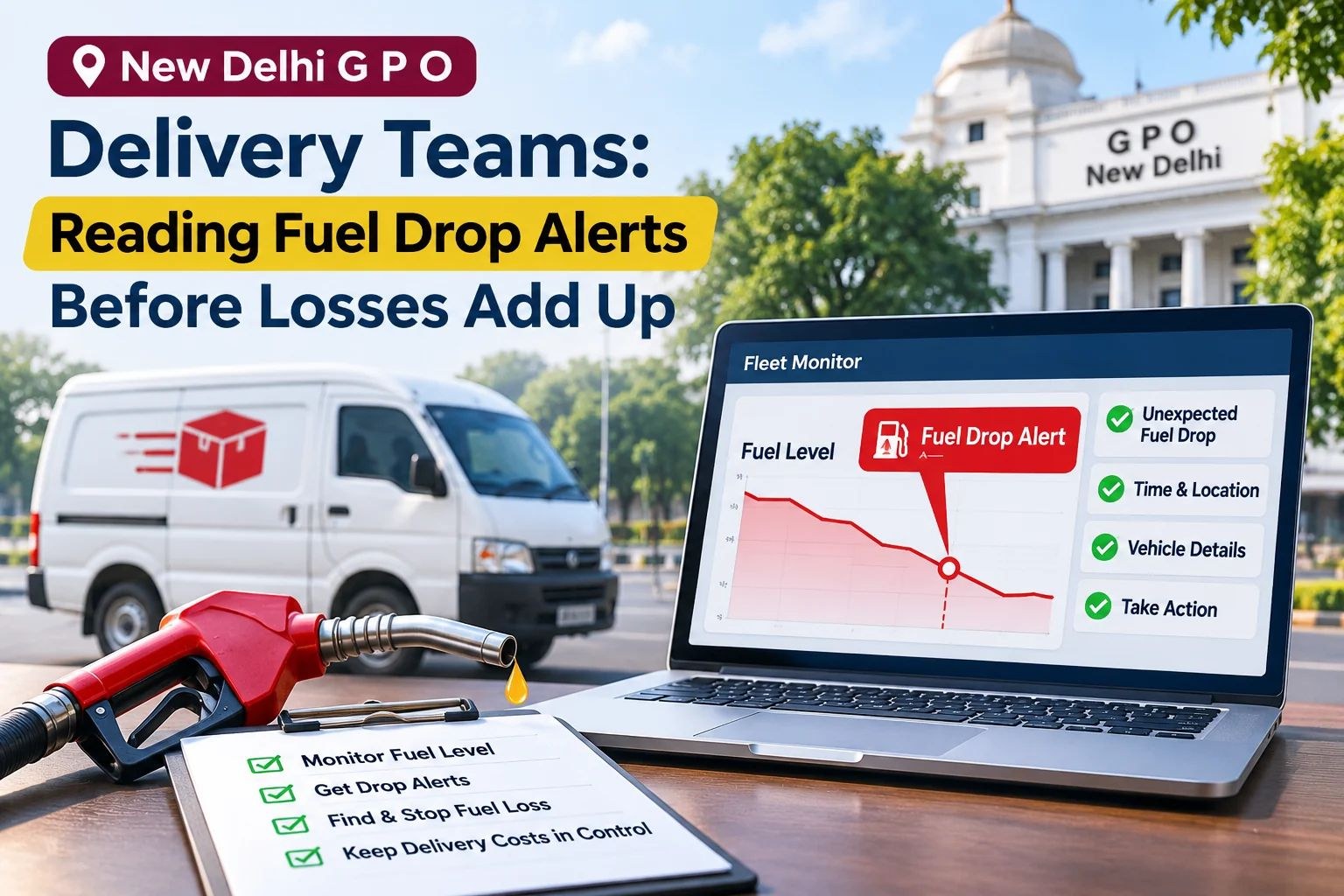
New Delhi G.P.O. Delivery Teams: Reading Fuel Drop Alerts Before Losses Add Up immobilizer
A fuel drop alert is a measured fall in fuel level over a set period, nothing more. It does not name a cause. Delivery teams in New Delhi G.P.O., and anywhere else, need to read that fall against a time window and the surrounding context before deciding whether it points to a refill event, a leak or suspected siphoning.
That single habit separates a quick internal check from a slow dispute. Read the window first, then the pattern, then the vehicle.
What a fuel drop alert is actually telling you
The signal is narrow by design: the reported fuel level fell by more than your configured threshold across a defined window. Treat the alert as a pointer to a stretch of time, not a verdict.
Around that window you will usually find a refuel, a long idle, a parking break, or a slope that unsettled the float reading. Refuelling events, idle periods and stop times all sit in the same log you are already reading. The question is which of them lines up with the drop.
A commonly used heuristic, not a rule: a fall while the ignition is off, the vehicle is stationary and the location has not moved is worth investigating as suspected siphoning. A gradual decline that keeps going while the vehicle drives more often points to a leak or a sensor that has drifted. A late refill entry can look like a drop followed almost at once by a rise or a manual correction.
What actually happens once you run this at delivery scale
At volume, one alert is rarely alone. Several vehicles report a fall across the same morning, and every case wants a human eye on a chart.
Signal trouble is a common source of phantom drops. A sensor under a covered roof or in a basement bay may lose signal and report late, which is a possible explanation worth checking before assuming fuel was lost.
As an example assumption rather than a measured fact, some devices might report fuel level on a slower cadence than location. If so, a sharp move seen on the map may not yet appear in the fuel field, and the timing gap, not the fuel, could be prompting the alert. Smaller numbers of vehicles can absorb manual cross-checks that larger ones cannot, so the cadence question matters more as the count grows.
Where teams misjudge the alert and lose the argument
The costliest mistake is treating one low reading as a closed case. Before anyone questions a driver, check whether a refill was logged late or the sensor drifted after a tank change.
Rushing a finding carries a risk that outlives the fuel itself. A wrong accusation damages trust, and trust is harder to rebuild than a tank is to refill.
Keep your records in order as well. If a fuel alert cannot be tied to a timestamped trip record, defending that finding in a routine review becomes harder. That is a practical risk, not an absolute one, and the fuel performance monitoring view is where many teams reconcile the alert against the trip before asking anyone anything.
Related Articles
Civic Centre Fleet Teams: Fuel Filling Detection Versus a Fuel Leak | Protect your ride with a GPS tracker for bike. Discover how these anti-theft devices offer real-time location, geofencing, and peace of mind. | GPS Controller Immobilizer Control Integration Cuts Theft Recovery Time for Heavy Equipment Assets in Remote Yards
The decision point between tuning and replacing
There is a boundary here, and it is about evidence quality rather than a fixed rule. Use it as a generic framework.
Start with the time window. If alerts reconcile cleanly once you widen the threshold and line up the reporting periods, the configuration is doing its job and you tune. If reconciliation only works after manual correction each time, look at the sensor mapping and reporting cadence next.
The harder case is calibration. If the fuel field and the location field do not line up across a full tank cycle, or the sensor will not hold steady from full to empty, threshold changes will not settle it. At that stage the question is whether the reporting pipeline needs redesign, not whether a number needs adjusting.
Practical decision points
Treat the response as a short sequence: detect, check the window, read the cues, inspect the vehicle, then record the outcome.
Start with the window, not the driver. Pull the fuel and location fields for the two hours around the alert, then check for a refill or a stoppage inside that range.
Stationary, ignition off, no movement. This is a widely used siphoning heuristic. A decline that continues while the vehicle is running suggests a leak or sensor drift instead.
Recurring drops at one spot. If alerts cluster around a covered bay, signal loss and late reporting are worth ruling out before you look at the tank.
Escalation signal. When a driver has been questioned twice on alerts that later reconciled cleanly, fix the alerting before the next case lands.
Record for verification. Log the timestamp, the trip identifier, the level before and after, the window you checked, the reconciliation outcome, and the inspection result. An undocumented finding rarely survives a review, and the blog carries related reconciliation notes worth keeping alongside it.
If you want to compare how a platform handles fuel level drops, refill events and suspected siphoning on your own vehicles, get in touch to talk through a platform demo, setup or device compatibility.
Ready to Put This Into Practice for Your Fleet?
GPS Controller supplies commercial 4G GPS trackers, fuel sensors, AI dashcams, cloud tracking software (Web, Android & iOS), and turnkey white-label reseller platforms.
Telematics & fleet technology team at GPS Controller (Sector 62, Noida, India), publishing technical guides on commercial GPS hardware, fuel monitoring, cloud fleet software, and white-label GPS platforms.
Related Telematics Guides
GPS Signal Delay Causing Fleet Tracking Failure
GPS Signal Delay Causing Fleet Tracking Failure GPS signal delay in dense urban areas and under heavy canopy cover causes fleet tracking failure by producing stale location data that does not reflect actual vehicle positions. For connected...
GPS Controller IDC AI spend 1.3 trillion 2029 fleet management core segment 2026
GPS Controller IDC AI spend 1.3 trillion 2029 fleet management core segment 2026 Fleet management in 2026 is the core segment staring down real consequences from the projected $1.3 trillion global AI spend by 2029. GPS signal delay—from inc...
GPS Controller free trial no contract setup in 10 minutes India 2026
GPS Controller free trial no contract setup in 10 minutes India 2026 Fleet managers across India are turning to the GPS Controller free trial no contract setup in 10 minutes India 2026 offer to resolve last-mile connectivity gaps without lo...
GPS Controller Real Time Ignition Engine Hours Total Movement Dashboard 2026
GPS Controller Real Time Ignition Engine Hours Total Movement Dashboard 2026 Operators relying on a GPS Controller real time dashboard for ignition engine hours compared to total movement data in 2026 are encountering persistent tracking fa...