
Karol Bagh Operators: Fuel Filling Detection Versus a Fuel Leak
In Karol Bagh, many operators meet the same question at the end of a shift: the truck came back with a tank reading lower than expected, or higher than expected, and nobody agrees
Karol Bagh Operators: Fuel Filling Detection Versus a Fuel Leak
In Karol Bagh, many operators meet the same question at the end of a shift: the truck came back with a tank reading lower than expected, or higher than expected, and nobody agrees on what happened. The practical outcome you want is simple. You should be able to say whether that change was a refill or a loss, or admit the data is too thin to tell, and act on that answer without blaming a driver by default. Fuel level data is a sampled reading, not a film of the tank, so the method matters more than the single number.
This guide uses one reading method across the whole article: check the direction of the change, check how long it persists, then corroborate it with trip and stop data. A refill usually shows a sustained upward step. A leak or drop usually shows a sustained downward step. Direction and persistence carry more weight than any one reading, and corroboration is what turns a suspicion into a decision.
How a refill appears in fuel level data
A refill normally appears as an upward step in the fuel level that holds after the vehicle starts moving again.
The two things worth checking are direction and persistence. Direction: the level goes up, not down. Persistence: the higher level stays in place over the next trips instead of sinking back within a short while. A rise that holds is a refill signal. A rise that fades is more likely a reading that corrected itself, which is why one jump alone should not be logged as proof of a filling event.
A refill also tends to arrive with company. There is usually a stop before it, then a period where the vehicle is not moving, then a resumption of the trip. If you use fuel performance monitoring, the timestamp of the rise can be lined up against that stop window. When the rise sits inside the stop and holds afterwards, the case for a refill is strong. When the rise appears mid-trip with no stop around it, treat it as unexplained until something else supports it.
A refill entered by can without a card swipe or log entry is still a refill in the data. It is a record-keeping gap, not evidence of anything else. Keep that distinction clean, because mixing the two is where most disputes begin.
How a leak or drop differs
A leak or drop normally appears as a downward step or a steady decline in fuel level that does not reverse when the vehicle is refuelled and then used again.
The reading method stays the same. Direction: the level goes down. Persistence: the loss does not come back, and it repeats across separate trips or separate days. A single downward step on a rough road can be movement in the tank rather than a loss, so a first drop is a reason to look, not a reason to conclude.
Here is the plain comparison, kept to the three signals that matter. On direction, a refill goes up and a leak goes down. On persistence, a refill stays high and a leak keeps slipping. On corroboration, a refill lines up with a stop and a later normal trip, while a leak has no refuelling event to explain it and keeps appearing while distance and usage look ordinary.
One boundary is worth setting early. A downward change recorded while the vehicle is stationary with the ignition off deserves a closer look than the same change recorded mid-trip, because there is no driving activity to account for it. Confirm that with the stop and ignition data rather than assuming it from the level trace alone. A wiring or sensor fault is one possible explanation to rule out, not a conclusion to jump to.
Cross-checking with trip and stop data
Cross-checking means placing the fuel level change next to what the vehicle was doing at that moment, so a refill, a loss, and sensor noise can be separated.
Three checks do most of the work. First, the stop: was there a stationary period around the change, and how long did it last? Second, the ignition state: was the engine off during the change, or running? Third, movement: did the vehicle cover normal distance before and after, or was it parked for most of the window? A change during a stop with the engine off, followed by a normal trip, reads differently from a change during a long idle period with no refuelling stop anywhere near it.
Related Articles
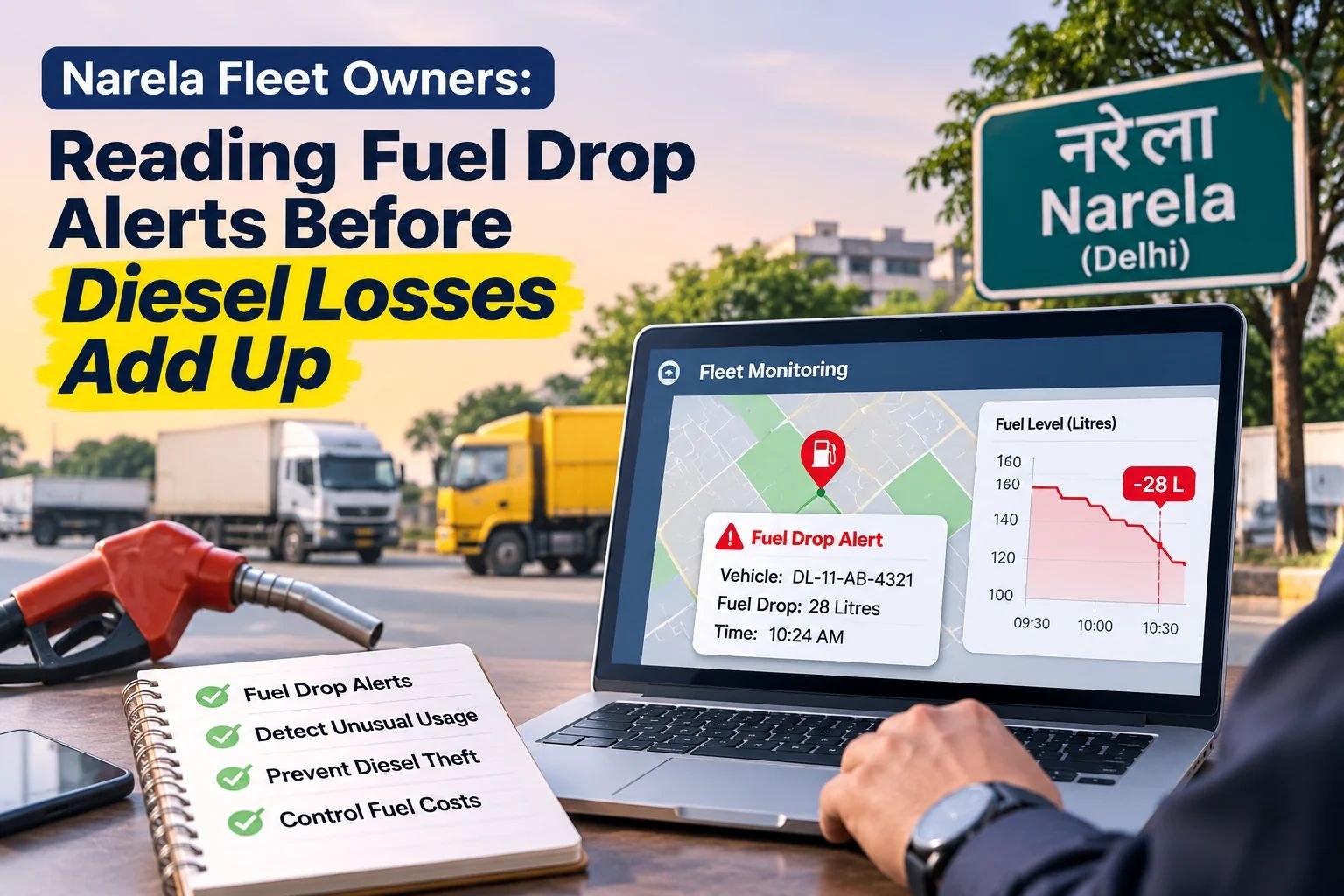
Narela Fleet Owners: Reading Fuel Drop Alerts Before Diesel Losses Add Up | AMPC Delivery Teams in New Delhi: Last Known Location When a Vehicle Goes Offline | AI Dashcam Alerts Prevent Truck Accidents on Indian Highways
Trip distance is the sanity check that a single level step cannot give you. Distance covered against fuel used is rough, but it is independent of the level sensor. If the level says the tank dropped sharply while the vehicle covered its usual distance on its usual route, you have a conflict worth investigating. If the level dropped and the distance also fell short, the drop has a plausible explanation in usage.
This is where custom reports and analytics help, because you can pull the level series, the stop durations and the trip distance into one view instead of reading three screens. The point is not the report itself. The point is having one timestamped record you can walk through with the driver and the depot.
When to escalate a fuel drop
Escalate when the same vehicle shows repeated, unexplained downward steps that persist across trips and have no refuelling stop or usage pattern to explain them.
That is the reader-side rule, and it is deliberately narrow. One drop is noise until proven otherwise. A pattern across several days, with no matching stop, no matching distance shortfall and no refill to account for the recovery, is the point where a conversation and a physical check are justified.
Before you escalate, confirm three things on the record. The level trace itself, timestamped. The stop and ignition state around each change. The trip distance for the same window. If those three agree that fuel left the tank without a refill and without the driving to explain it, you have a case. If they disagree, you have a data problem, and the fix belongs with the sensor path rather than with the driver.
Keep the record-keeping side honest too. An alert count is not an audit trail on its own. What holds up later is the underlying series, the stop duration and the distance for the same period, kept together. And keep the escalation proportionate: a repeating shape is a signal, a single anomaly is not. If the trace itself is erratic, drifting, or stuck at one value for hours, no threshold setting will make it readable, and the work moves to the mounting, the wiring and the reporting path feeding the controller. That is a hardware and integration question, not a settings question.
Check direction first: a rise that holds points to a refill, a fall that keeps slipping points to a loss.
Check persistence second: a change that reverses within the next trip is weak evidence; one that repeats across days is not.
Corroborate with the stop, the ignition state and the trip distance before drawing any conclusion about a driver.
Treat a refill with no card swipe or log entry as a record gap, and note it as one.
Start with a checklist of those three signals per vehicle, then review the pattern across a week of trips before escalating.
Ready to Put This Into Practice for Your Fleet?
GPS Controller supplies commercial 4G GPS trackers, fuel sensors, AI dashcams, cloud tracking software (Web, Android & iOS), and turnkey white-label reseller platforms.
Telematics & fleet technology team at GPS Controller (Sector 62, Noida, India), publishing technical guides on commercial GPS hardware, fuel monitoring, cloud fleet software, and white-label GPS platforms.
Related Telematics Guides
GPS Signal Delay Causing Fleet Tracking Failure
GPS Signal Delay Causing Fleet Tracking Failure GPS signal delay in dense urban areas and under heavy canopy cover causes fleet tracking failure by producing stale location data that does not reflect actual vehicle positions. For connected...
GPS Controller IDC AI spend 1.3 trillion 2029 fleet management core segment 2026
GPS Controller IDC AI spend 1.3 trillion 2029 fleet management core segment 2026 Fleet management in 2026 is the core segment staring down real consequences from the projected $1.3 trillion global AI spend by 2029. GPS signal delay—from inc...
GPS Controller free trial no contract setup in 10 minutes India 2026
GPS Controller free trial no contract setup in 10 minutes India 2026 Fleet managers across India are turning to the GPS Controller free trial no contract setup in 10 minutes India 2026 offer to resolve last-mile connectivity gaps without lo...
GPS Controller Real Time Ignition Engine Hours Total Movement Dashboard 2026
GPS Controller Real Time Ignition Engine Hours Total Movement Dashboard 2026 Operators relying on a GPS Controller real time dashboard for ignition engine hours compared to total movement data in 2026 are encountering persistent tracking fa...